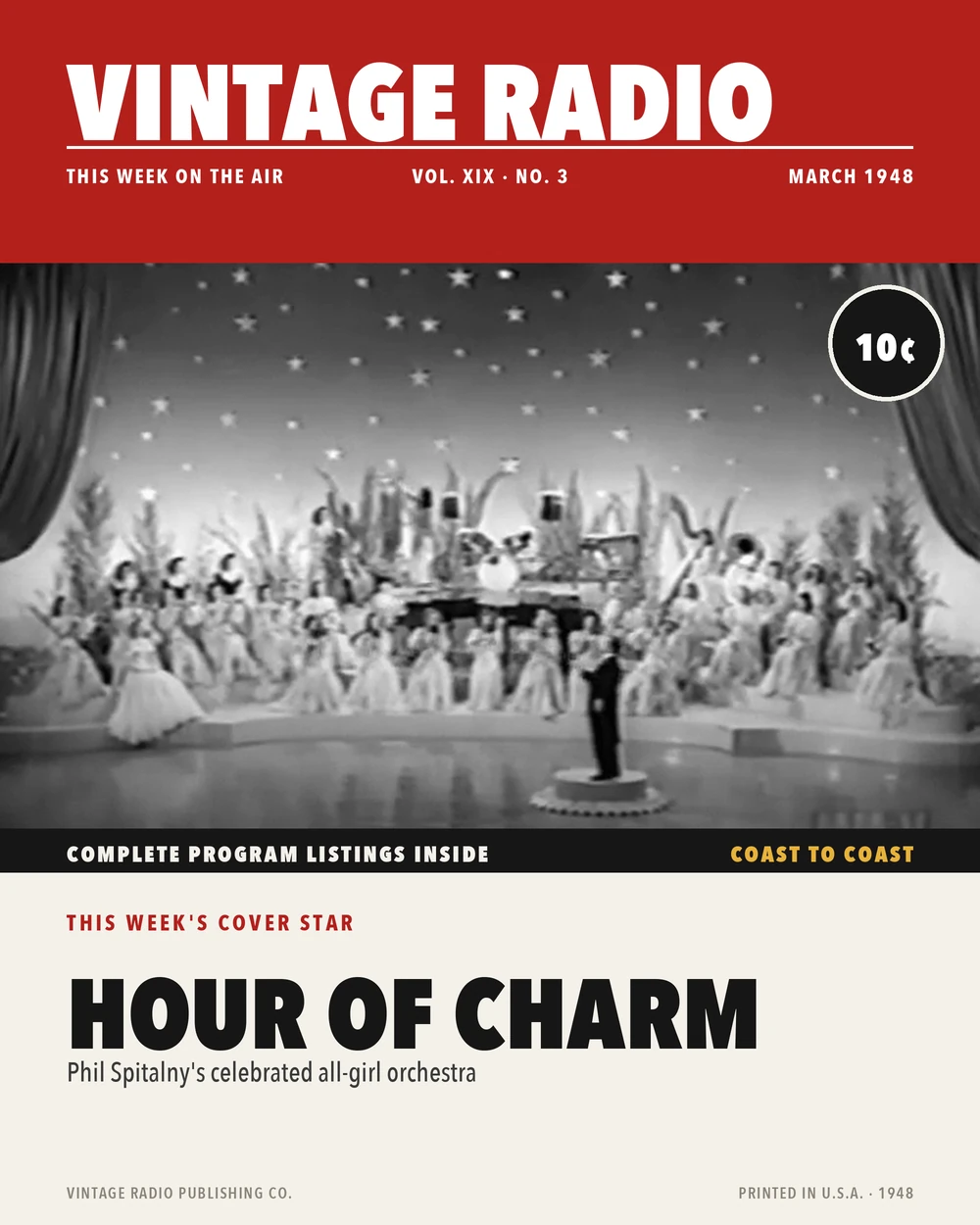
Hour of Charm
The Idea Nobody Believed In
Phil Spitalny didn't set out to build a radio institution. The spark came in 1932, when he witnessed a concert performance by a brilliant female violinist that he found genuinely electrifying. He walked away convinced that an all-female orchestra, built to the highest professional standard, could hold its own against anything on the air. Most of his peers thought he was out of his mind. A 1958 newspaper retrospective on Spitalny recalled "ridicule from all sides in show business" and "sour comments from his musician brothers that he was crazy" as he set about creating what the paper called "the first all-girl band of any consequence ever organized."
Spitalny had earned enough credibility by then that the ridicule didn't stop him. Born in Tetiyev in the Russian Empire — present-day Ukraine — on November 7, 1890, he had studied clarinet as a child prodigy at the Odessa Conservatory before immigrating to the United States in 1905 or 1906. His family settled in Cleveland, where he and his brother Leopold played in the dining room orchestra at the Hotel Statler. By his early thirties he had directed a 50-piece symphony orchestra in Boston, joined the original Cleveland Symphony Orchestra when it was established in 1918, conducted touring orchestras that recorded for Victor, Edison, Hit of the Week, and Perfect, made his New York debut in 1930, and completed a successful world tour. When he dissolved his all-male orchestra to go looking for female talent, he knew exactly what he was giving up.
The search was grueling. Spitalny auditioned women in New York, Chicago, Pittsburgh, Detroit, and Cleveland. Pittsburgh, he said, didn't have a single female musician capable of meeting his standards. At New York's Juilliard School of Music he met Evelyn Kaye Klein, a violinist who became not just the orchestra's concertmistress but his partner in the talent hunt. Together they widened the search into smaller communities, reasoning that women there had more time to practice and develop real technique. The audition figures across sources are inconsistent — somewhere between $20,000 and $40,000 spent, and somewhere between 1,000 and 1,500 musicians heard — but the scale of the effort isn't in dispute. After roughly a year of searching, Spitalny had his first all-girl orchestra assembled, debuted it at the Capitol Theatre in New York City in 1934, and took it to CBS.
How It Got on the Air
The Hour of Charm launched on CBS on May 18, 1934, in 15-minute Friday evening slots sponsored by Cheramy. It moved to Wednesdays later that summer, then returned the following January for a longer Thursday night run under Linit Bath Oil. What made the Linit audition worth noting is that it was a blind test — the music was piped in from a remote location so the sponsors couldn't see who was playing. Linit bought the show anyway, despite some initial hesitation, signing a 13-week contract that extended to six months. That 26-week Thursday run registered a 7.2 CAB rating even while competing directly against Rudy Vallee's Fleischmann Hour on NBC.
A 1936 run under Zotos Machineless Permanent Wave dropped to a 3.1 CAB, the program's all-time low. Then General Electric came aboard for the NBC run beginning November 2, 1936 — a sponsorship that would last ten years. The early GE ratings weren't strong either, just 3.3 in the first half-season, but the show found its footing. By the end of the 1938–39 season it posted a 7.9 Hooperating on Monday nights, ranking 69th among all programs nationally. General Electric then moved it to NBC Sunday nights at 10:00 p.m., where it averaged a 9.2 Hooperating running against the comedy quiz Take It or Leave It on CBS. The program's single best stretch came when it was slotted between Fibber McGee & Molly and The Carnation Contented Hour, with only the final half of Lux Radio Theater opposing it on CBS. After the NBC run ended in September 1946, the show moved back to CBS for a final run under combined electric co-ops, closing on May 2, 1948.
The Sound and the Standards
Spitalny's musical concept sat at the intersection of popular and symphonic, in his own description — a cross between the two rather than a full commitment to either. The arrangements, written by three members of the orchestra themselves, leaned on piano, harp, and strings while keeping saxophones, trombones, and trumpets in the background. Sherrie Tucker, in her book Swing Shift: 'All-Girl' Bands of the 1940s, described the orchestra's trademark effects as "quivering strings, dramatic brass fanfares, galloping rhythms, and sweeping flurries from the harp." A Billboard review from March 1936 called it "a tuneful affair, revealing several excellent arrangements, the better ones being of the South American tang." A later Billboard review from December 1938 found the package overdone — "so laden with arrangements, production trappings, descriptions of the girls' clothes and talents...that it sounded more like the Ford Sunday Evening Symphony than a dance remote" — but the audience kept listening.
The show opened and closed with hymns, particularly during the war years. The opening theme was "The American Hymn of Liberty." The closing signature blended out of that theme into "We Must Be Vigilant," sung by the orchestra to the tune of "American Patrol," with lyrics by Edgar Leslie and music adapted by Joseph A. Burke from F. W. Meacham's original. Often the closing featured a hymn favored by someone in military service. That bookending gave the broadcast a serious, almost solemn quality that separated it from ordinary variety fare. Conductor Arturo Toscanini reportedly called The Hour of Charm his favorite radio program, according to the August 1, 1942, issue of Billboard. Spitalny's own voice was never heard on the broadcasts — his name was mentioned exactly once, at the top of each program.
The People Who Made It Work
The orchestra's anchor was Evelyn Kaye Klein, billed on air simply as "Evelyn and Her Magic Violin." She served as both first violinist and concertmistress, and the violin she played — a 1756 Bergonzi — had been presented to her as an award from the Arts Club of America when she graduated from Juilliard. The three principals were Evelyn, soprano Vivien, and contralto Maxine; they wore evening gowns while the rest of the orchestra was in uniform white formal dresses. Later vocalists were billed as "the distinctive voices of Jeannie and Francine." A vocal trio called Three Little Words — Frances, Connie, and Fem — also performed on the show, as did piano duo Rochelle and Lola. The female performers used only their first names on the air.
Several instrumental players stood out. Viola Smith, who joined in 1942 after her previous all-female band the Coquettes dissolved, performed a showcase billed as "Viola and Her Seventeen Drums." A Billboard review of a January 1943 show at The Roxy singled her out alongside trumpeter Ruth as providing "a torrid bit of rhythm that is a highlight in the show," and a separate review of the orchestra's April 1943 Philadelphia engagement noted that "Viola Smith did a Gene Krupa at the drums." Jan Baker came aboard after Spitalny conducted a nationwide search and couldn't find a woman willing to play tuba — Baker, capable of a dozen instruments, simply learned it. Helen Blue and Velma handled trombone. Grace played guitar.
Mistresses of ceremonies included Rosaline Greene in the mid-1930s and Arlene Francis later in the decade. A Radio Guide article from the week ending July 28, 1939, noted that listeners "probably remember her best for her work during the months she was mistress of ceremonies on Phil Spitalny's Hour of Charm." Francis went on to become one of television's most recognized personalities. Ken Roberts announced from 1935 onward, with Ron Rawson and Richard Stark sharing announcing duties in the 1940s. Joseph Ripley directed the show.
The Rules of the House
Spitalny's hiring standards were meticulous. His 1940 Current Biography entry quoted his requirements: each performer had to deliver a finished rendition of two sonatas and two concertos, demonstrate individual gifts of rhythm and melodic perception, read music fluently, and bring substantial prior experience. He recruited heavily from conservatory graduates and preferred candidates from small towns. Musicianship came first, but voice and appearance also figured into his decisions.
The internal rules were equally rigorous. No performer was allowed to weigh more than 122 pounds. Contracts required performers to remain single, with six months' notice required before marrying. A committee of five passed judgment on offstage matters including dating — a member had to submit a date request with references, and the committee could veto it. Evelyn Kaye Klein, writing in a 1942 Radio Life article, compared life in the orchestra to sorority life. Spitalny drew a deliberate contrast with what he called the "blatant sex appeal" of rival all-female bandleader Ina Ray Hutton's Melodears — his presentation emphasized class and decorum. He also noted with some satisfaction that his orchestra had no problems with alcohol among its members, and that during World War II his was the only band unaffected by the draft.
The financial structure was unusual. The orchestra operated as a stock company, with each member owning shares proportional to her role. At year's end, profits were distributed according to those shares on top of regular salaries. By the mid-1940s the core radio broadcast orchestra numbered 45 women; for concert tours, approximately 25 additional players were added.
After the Radio Years
Phil Spitalny married Evelyn Kaye Klein on June 11, 1946, outside Atlantic City, while the show was still on the air. When the network run ended in 1948, the orchestra didn't immediately stop. The show had been broadcast on Armed Forces Radio during the war, and afterward a syndicated version went out via transcriptions. In 1951 the RCA Thesaurus electrical transcription service launched a new Hour of Charm radio series. The orchestra continued touring concert stages until Spitalny disbanded the group around 1954 or 1955. In January 1949, after the radio show had closed, Spitalny and the orchestra performed at President Harry S. Truman's inaugural ball.
The group had also built a substantial film record — short subjects for Paramount, Warner Brothers, and Universal, plus two Universal features: When Johnny Comes Marching Home (1942), where the orchestra played female musicians filling in for men serving overseas, and Here Come the Co-Eds (1945). A Variety review of a late December 1942 Town Hall concert in New York opened: "When show business talks in terms of versatility, put down the name Phil Spitalny." The orchestra also appeared on Ed Sullivan's television program Toast of the Town, and a clip of that performance survives.
On the recording side, the orchestra released a 78-rpm album of hymns for Columbia in 1941, later reissued as a 10-inch LP. Columbia also put out "Favorite Melodies From the Hour of Charm" and a solo album for Evelyn. In 1948 Spitalny launched his own Charm Records imprint, and after he began recording for RCA Victor in 1950, a Christmas carols album appeared on that label. The Christmas album charted on Billboard's bestselling popular record albums list in late 1948 and early 1949. The orchestra also received formal recognition during its run: in 1937 the Radio Committee of the Women's National Exposition of Arts and Industries gave it its Achievement Award for the most distinguished work by women in radio that year.
Spitalny retired to Miami Beach, where he served as a music critic for a local newspaper. He died on October 11, 1970, and holds a star on the Hollywood Walk of Fame. Evelyn Kaye Klein survived him by twenty years, dying in 1990. Viola Smith outlived them both by decades, eventually joining the pit orchestra for the original Broadway production of Cabaret in 1966, where she remained until 1969. She died on October 21, 2020, at the age of 107.